Friday, January 1, 2016

SICB 2016 Schedule

Here are some #SICB2016 presentations I have marked after key word searches. What great ones am I missing?


Day
Session/Paper#TimeRoomAuthor 1Title
Monday, Jan. 4 22-1 10:15 C125/126 SCHNITZLER, CEGenomics of Hydractinia: A Cnidarian Model for Regeneration, Allorecognition, and Developmental Biology 
Monday, Jan. 4 33-5 14:30 C125/126 VON DASSOW, MThe echinoid blastula: linking biomechanics to development-environment interactions 
Monday, Jan. 4 33-6 14:45 C125/126 SERVETNICK, MDCRISPR/Cas9-mediated excision of the brachyury gene disrupts endoderm development in the sea anemone Nematostella vectensis. 
Monday, Jan. 4 P1-143 15:30 Exhibit Hall A DONOHUE, M.W.Behavioral and molecular evidence for opsin-based extraocular photoreception in stomatopod crustaceans 
Monday, Jan. 4 P1-157 15:30 Exhibit Hall A ARUL NAMBI RAJAN, ANeural Determinants of Behavior in an Organism without a Nervous System 
Monday, Jan. 4 P1-162 15:30 Exhibit Hall A PRICE, C.L.The genetics of the visual system of two species of pupfishes (genus Cyprinodon) 
Monday, Jan. 4 P1-147 15:30 Exhibit Hall A PICCIANI, N.Light modulated cnidocyte firing predates the evolution of eyes in Cnidaria (Metazoa) 
Monday, Jan. 4 P1-144 15:30 Exhibit Hall A NOTAR, JCA Comparative Study of Sea Urchin Visual Ecology  
Monday, Jan. 4 P1-145 15:30 Exhibit Hall A MILLER, H.V.Pupillary responses in scallops 
Monday, Jan. 4 P1-78 15:30 Exhibit Hall A SIMMONS, SMesoglea and Muscle in Cubozoan Jellyfish Carybdea marsupialis and Tripedalia cystophora 
Monday, Jan. 4 P1-22 15:30 Exhibit Hall A MUNRO, CExploring the evolution of functional specialization in siphonophores using RNAseq 
Monday, Jan. 4 P1-148 15:30 Exhibit Hall A SWAFFORD, A.J.Gain and Loss of Sensory Modalities Alter Guidance of Allomyces Zoospores 
Tuesday, Jan. 5 S4-2 08:00 C123 PORTER, M.L.Beyond the eye: extraocular opsin evolution 
Tuesday, Jan. 5 S4-3 08:30 C123 COLLEY, N.J.Photoreception in Phytoplankton 
Tuesday, Jan. 5 40-4 08:45 B114 DALTON, B ECoexpression of opsins in each cone class spectrally tunes regions of the retina to distinct parts of the visual field 
Tuesday, Jan. 5 S4-4 09:00 C123 OAKLEY, THOpsins without eyes – precursors or derivatives? 
Tuesday, Jan. 5 40-6 09:15 B114 FAULKES, Z.Eyes under the beach: the visual system of sand crabs (Lepidopa benedicti) 
Tuesday, Jan. 5 S4-6 10:30 C123 KINGSTON, ACNExtraocular opsins in skin and nervous systems of aquatic animals 
Tuesday, Jan. 5 S4-7 11:00 C123 BATTELLE, B-AOcular and extraocular photosensitivity and opsin expression in the American horseshoe crabLimulus polyphemus, a chelicerate arthropod. 
Tuesday, Jan. 5 S4-8 11:30 C123 BOK, M.J.Looking with gills: The function and evolution of fan worm branchial photoreceptors 
Tuesday, Jan. 5 S4-9 13:30 C123 WALKER, Marquis T.A mouse homolog of Drosophila RDGB functions in ipRGC dim light activation 
Tuesday, Jan. 5 68-1 13:45 B118/119 DALY, MThe tree’s the thing: phylogeny as a way of understanding the diversity of venom in sea anemones 
Tuesday, Jan. 5 67-1 14:00 B117 LARSON, P.G.Evaluating taxonomic characters of Anthopleura and other sea anemones in a molecular phylogenetic context 
Tuesday, Jan. 5 S4-10 14:00 C123 SCHMIDT, T.M.New roles for ganglion cell photoreceptors 
Tuesday, Jan. 5 67-2 14:15 B117 MACRANDER, JA High-Throughput Investigation into the Tissue Specific Venom Composition and Differential Gene Expression in Three Species of Sea Anemone 
Tuesday, Jan. 5 67-3 14:30 B117 GOODHEART, J.A.Phylogenomics of Cladobranchia (Mollusca: Gastropoda: Heterobranchia) 
Tuesday, Jan. 5 S4-11 14:30 C123 SPEISER, D.I.Eyes most numerous: extracephalic visual systems in molluscs 
Tuesday, Jan. 5 67-4 14:45 B117 CHANG, J.The tempo of body shape evolution in ray-finned fishes: bringing morphology into the “phenomic era” with crowdsourced morphometrics 
Tuesday, Jan. 5 S4-12 15:00 C123 JOHNSEN, S.What Next? Unanswered questions about extraocular photoreception and how we might answer them  
Tuesday, Jan. 5 P2-136 15:30 Exhibit Hall A STABILE, F. A.Identification of four genes involved in the development of feathers but not scales in birds 
Tuesday, Jan. 5 P2-156 15:30 Exhibit Hall A MURPHY, P.J.Regional Genetic Variation of Two Ephemeral Pool Crustacean Species: Implications for Visual System Plasticity or Local Adaptation 
Wednesday, Jan. 6 74-1 08:00 B112 BABONIS, L.S.Seeing without eyes: Opsins and the evolution of photodetection in basal metazoans 
Wednesday, Jan. 6 79-2 08:15 B118/119 MCCULLOCH, KJPhotoreceptor Cell Sensitivity and Sexual Dimorphism in the Compound Eye of the ButterflyHeliconius erato 
Wednesday, Jan. 6 74-4 08:45 B112 MASON, B.M.Coral opsins: photosensitivity and partial characterization of five opsins from Acropora millepora 
Wednesday, Jan. 6 74-5 09:00 B112 SERB, J.M.Expression and spectral analysis of two Gq-opsins from the mantle and the eyes of the scallop Placopecten magellanicus  
Wednesday, Jan. 6 74-6 09:15 B112 FAGGIONATO, D.Spectra analysis of Gq-opsins from four scallop species 
Wednesday, Jan. 6 74-7 09:30 B112 BRANDLEY, NDo warning signals exploit an evolutionary constraint on insect visual acuity? 
Wednesday, Jan. 6 85-1 10:15 B112 THOMAS, K.N.The perks of being cock-eyed: Orientation and visual characteristics of histioteuthid squids 
Wednesday, Jan. 6 85-2 10:30 B112 HOLT, A.L.Light guides and open water camouflage in Galiteuthis 
Wednesday, Jan. 6 85-3 10:45 B112 CAVES, EMVisual acuity in fish: the effects of eye morphology, environment, and ecology 
Wednesday, Jan. 6 85-4 11:00 B112 JOHNSEN, S.Another beautiful hypothesis slain by an ugly fact: Polarization vision does not increase the sighting distance of silvery fish 
Wednesday, Jan. 6 85-5 11:15 B112 DODSON, TOrigins of Polydispersity In Cephalopod Photonic Systems - Are Squids Masters of RNA Editing? 
Wednesday, Jan. 6 96-2 13:45 B112 EMERLING, C.A.Spectral shifts of mammalian ultraviolet-sensitive pigments (SWS1) are associated with eye length and photic niche evolution 
Wednesday, Jan. 6 92-3 14:00 A104 CORYELL, R.L.Phylogeographic patterns in the Philippine archipelago drive symbiont diversity in the bobtail squid-Vibrio mutualism 
Wednesday, Jan. 6 101-4 14:15 B118/119 MOROZ, LLCan Synapses Evolve Independently? 
Wednesday, Jan. 6 S8-10 14:30 C124 LEWIS, C.Differential expression of genes implicated in venom, vision and sex in the aggregating box jellyfish Alatina alata 
Wednesday, Jan. 6 P3-198 15:30 Exhibit Hall A LIN, C.Neural organization of the optic lobes in the two midband-row stomatopod Squilla empusa 
Wednesday, Jan. 6 P3-16 15:30 Exhibit Hall A STERN, D.B.Comparative Vision Gene Expression in Cave Adapted Crayfish 
Thursday, Jan. 7 115-1 10:15 A107-109 ADAMS, DKEvolution of the neurosensory system mediates gain and loss of phenotypic plasticity 
Thursday, Jan. 7 114-4 11:00 A105 KELLY, MWAdaptation to heat stress reduces phenotypic and gene expression plasticity in a marine copepod 
Thursday, Jan. 7 116-6 11:30 B110-111 SCHWEIKERT, LERed Fish, Blue Fish: Wavelength Sensitivity of the Marine Fish Retina Adjusts to Transient Changes in Environmental Light Color 
Thursday, Jan. 7 115-7 11:30 A107-109 KOENIG, KMMaking an Eye: Optic Vesicle Morphogenesis in the Cephalopod Doryteuthis pealeii 
Use this button to remove checked items from your personal schedule.

Friday, November 6, 2015

Postdoctoral Position in Ecological Genomics at UCSB

Postdoctoral Researcher in Ecological and Evolutionary Genomics

We seek a researcher to lead the genomics aspects of an interdisciplinary research program on algal ecology and biofuels. The candidate will work at UCSB in the lab of Todd Oakley and collaborate with ecologists and engineers at the University of Michigan. This project was awarded by the National Science Foundation through its Emerging Frontiers in Research and Innovation (EFRI) initiative. The team is testing the hypothesis that certain naturally diverse groups of algae have complementary traits that enhance the efficiency and stability of biofuel yield beyond what any single species can achieve alone. The UCSB members of the team are testing whether gene expression differences under different ecological conditions correlate with measures biofuel yield.

The minimum requirement is a PhD in bioinformatics, genomics or a related field. Applicant should also be comfortable working in a collaborative, interdisciplinary environment, which requires excellent written and oral communication skills. The applicant should be able to handle large transcriptomic and genomic data sets, and be adept at coding (Python, PERL, or similar) and at using and implementing bioinformatics software.

Applicants should submit a cover letter, curriculum vitae, research statement, summary of research experience, publications. In addition, supply contact information for 3 colleagues willing to provide letters of recommendation (we will contact the letter writers for a short list of candidates).

We will begin to review applications immediately, but apply by Dec 1, 2015 for full consideration. Please direct questions or informal inquiries to Todd Oakley (oakley@lifesci.ucsb.edu).

The department is interested in candidates who can contribute to the diversity and excellence of the academic community through research, teaching and service. The University of California is an Equal Opportunity/Affirmative Action Employer. All qualified applicants will receive consideration for employment without regard to race, color, religion, sex, national origin, or any other characteristic protected by law including protected Veterans and individuals with disabilities.

Wednesday, October 28, 2015

How old are fireflies?

This is an "open lab notebook" detailing an analysis I did trying to figure out how old are fireflies.


Are fireflies - beetles who use light for courtship - more diverse than expected from the age of their lineage? Answering this question in part depends on knowing the age of the clades.

In this analysis, I come up with a very rough estimate that one firefly clade is 145 MY and another is 128 MY. Divergence time estimation is notoriously error-prone and these estimates are based on a number of assumptions. They should therefore be taken with a (large) grain of salt, ie be skeptical.

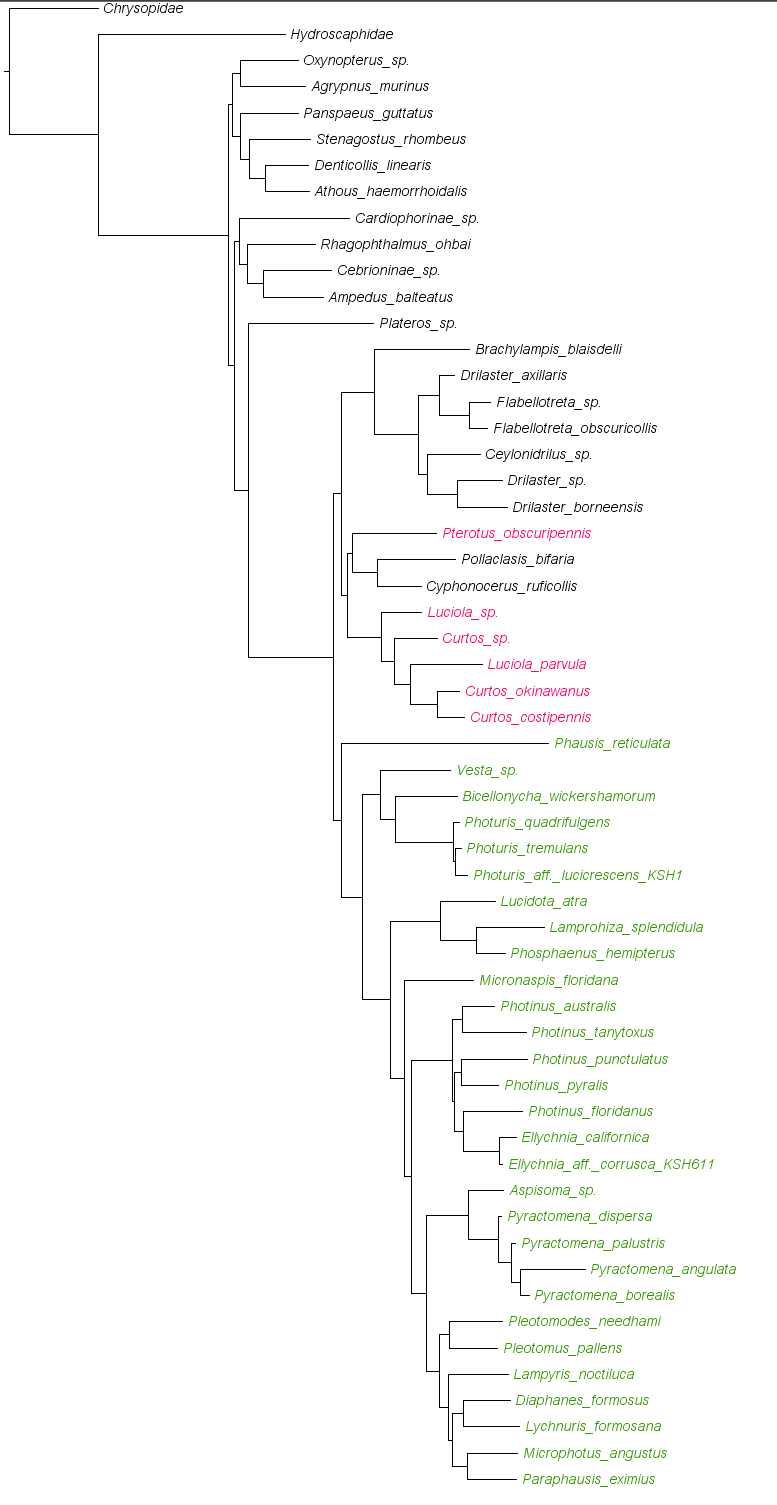
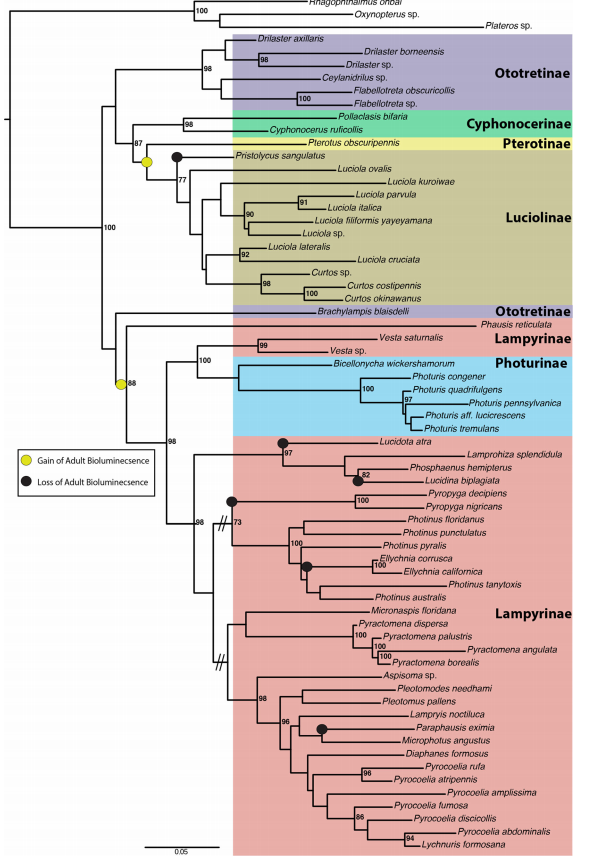
I began with the phylogeny of Martin et al. (2015). They concluded adult bioluminescence was originated twice in fireflies. One clade contains Lampyrinae+Photurinae, which I call ‘firefly1’. The other clade contains Pterotinae+Luciolinae - I call this the “firefly2” clade. This tree is based on 18S, 16S, and CO1, but did not do any divergence time analyses.


.

In order to estimate divergence times, I needed to include clades that could be constrained with fossils. I consulted Hunt et al. (2007), a phylogeny of all beetles, with divergence times. The closest clade to fireflies with a fossil constraint is their constraint “e”. This is Elaterophanes from 196.5 MY, used as a minimum age for the Elateridae. Hunt et al. (2007) used the same genes as Martin et al. (2015) (MEA), so I concatenated the MEA data set with elaterids from HEA. I also fixed beetles to be 285 MY, after Hunt et al. (2007). This is their estimate of divergence time for beetles. Using the fossil record could lead to a ‘maximum’ age of beetles as 411 (Rhynie Chert). But if I use 285 as a minimum and 411 as a maximum, the age gets pushed up to 411, which does not seem particularly realistic. Doing that raises the age estimates by some 40 MY-  for FF1 and FF2 to 186 and 164 MY, respectively.
I also included some other outgroups. First, I used a Hydroscaphidae because the MRCA of that clade and Lampyridae is the MRCA of all beetles. In addition, I used a non-beetle, Chrysopidae. These two taxa were the only species in HEA that had all 3 genes. For divtime analyses in r8s, I pruned the Chrysopidae to leave a rooted, fully resolved tree.

I required all 3 genes to be present for each species (using phylocatenator of Osiris (Oakley et al. 2014)). My tree had some differences with HEA and MEA:


  1. Elateridae are not monophyletic. With some different outgroups, I did get monophyly. HEA also consistently got monophyly. Perhaps adding Cantheridae (a closer sister to Lampyridae) would allow recovery of the expected monyphyly of elateridae. As a result, the divtime constraint is at the base of Elateridae AND Lampyridae, and could influence final results.
  2. Firefly 2 (red taxa) is not monophyletic as in MEA. Instead, I get Pollaclasis and Cyphonocerus within the Firefly2 clade. This could influence the time estimate for this clade. I could perhaps constrain monophyly here. Also other outgroups also could influence monophyly because Pterotus is the taxon changing places, and it is fairly long branch, and may be influenced by outgroups.


Data Files:

I used Osiris (Oakley et al. 2014) to build the phylogeny, which uses phytab format. That file is here.

I used r8s for the divergence time analysis, and that file is here:

#NEXUS


Begin TREES;

TREE 'Tree1' = ((((Oxynopterus_sp.:463.5249944,Agrypnus_murinus:526.2532825):58.07102708,(Panspaeus_guttatus:460.2987223,(Stenagostus_rhombeus:490.0649111,(Denticollis_linearis:345.0885786,Athous_haemorrhoidalis:348.234297):128.0768835):72.63022263):60.96422013):35.09443673,((((Phausis_reticulata:1662.289658,((((Lamprohiza_splendidula:544.0746241,Phosphaenus_hemipterus:229.7443014):285.1154906,Lucidota_atra:437.7055071):401.9635656,((((Photinus_australis:253.4245299,Photinus_tanytoxus:505.5902659):83.13503158,((Photinus_punctulatus:528.7843213,Photinus_pyralis:301.5064629):50.68180427,(Photinus_floridanus:473.4079674,(Ellychnia_californica:135.4824287,Ellychnia_aff._corrusca_KSH611:25.24849269):286.7912686):70.99285141):18.53357795):329.2700252,((Aspisoma_sp.:283.3096828,(Pyractomena_dispersa:29.67243287,(Pyractomena_palustris:31.23178185,(Pyractomena_angulata:517.0946069,Pyractomena_borealis:67.81801332):70.86493904):110.1146049):238.5808725):339.3010688,((Pleotomodes_needhami:426.6510094,Pleotomus_pallens:389.0211618):76.84583685,(Lampyris_noctiluca:477.2948781,((Diaphanes_formosus:371.9065228,Lychnuris_formosana:449.5272741):90.09984008,(Microphotus_angustus:406.2856534,Paraphausis_eximius:395.3158416):117.5049772):29.6282204):72.85630302):111.0228766):116.0625074):59.48984988,Micronaspis_floridana:558.9615698):107.7999852):229.3020886,(Vesta_sp.:561.4644596,(Bicellonycha_wickershamorum:491.2011309,((Photuris_tremulans:49.09336296,Photuris_aff._lucicrescens_KSH1:100.1688104):15.59686292,Photuris_quadrifulgens:50.11517938):457.7292255):121.0831356):150.8011019):163.8652632):66.19287172,((Brachylampis_blaisdelli:759.3860187,((Drilaster_axillaris:123.8337303,(Flabellotreta_sp.:171.4133031,Flabellotreta_obscuricollis:146.3672477):242.4682661):163.5674534,(Ceylonidrilus_sp.:422.4286714,(Drilaster_sp.:354.6668547,Drilaster_borneensis:394.0848821):241.6799973):72.15723681):351.5818484):270.4748514,((Luciola_sp.:326.8593145,((Luciola_parvula:576.0213995,(Curtos_okinawanus:182.2933313,Curtos_costipennis:220.7797732):214.4995191):130.4914738,Curtos_sp.:346.5873752):104.5451147):267.9094037,(Pterotus_obscuripennis:672.2005806,(Pollaclasis_bifaria:627.4316177,Cyphonocerus_ruficollis:348.7937363):198.7861435):41.84871305):52.94860049):62.12407915):680.5789337,Plateros_sp.:1002.688879):111.8242026,((Rhagophthalmus_ohbai:539.4926404,(Cebrioninae_sp.:547.7782899,Ampedus_balteatus:478.7696559):125.5329304):66.72017755,Cardiophorinae_sp.:883.3299248):39.872645):47.59526361):1043.317628,Hydroscaphidae:1499.20604);
End;

[** Beginning of the rates block containing commands for r8s **]

begin r8s;
blformat lengths=persite nsites=6417 ultrametric=no;

MRCA beetles Hydroscaphidae Drilaster_borneensis;
MRCA elateridae Cardiophorinae_sp. Panspaeus_guttatus;
MRCA firefly1 Phausis_reticulata Pleotomus_pallens;
MRCA firefly2 Pterotus_obscuripennis Luciola_parvula;


fixage taxon=beetles age=285;
#constrain taxon=beetles min_age=280 max_age=411;
constrain taxon=elateridae min_age=196.5;


divtime method=pl algorithm=tn [cvStart=0 cvInc=0.2 cvNum=8 crossv=yes];


describe plot=chrono_description;
showage shownamed=yes;

end;

References

Sunday, July 26, 2015

Graduating Little League

Before the actual day, I worried about the arrival of my 40th birthday. But when that day came, it felt like any other day. I was still me, just a day older. I felt the same for “Y2K”, the year 2000. After months of doomsday scenarios, January 1, 2000 was just like any other day that saw the sun rise and saw the sun set. All our computers still turned on. Partly because these were so normal, I am caught off-guard that today does not feel like any other day. As strange as it may sound, the end of my son's 12-year-old Little League year feels like I thought age 40 or Y2K might feel; like the end of an era. In many ways, my son and his baseball buddies are no longer children. Today, our boys have graduated Little League.

It is true that Little League goes on past age 12. But the 12-year-old year is the privileged year. The name of the 12U division is simply “Little League”, as if to assert the 12-year-old division is Little League. In our town, the 12 year-old division is top dog. It's considered first in scheduling games and practices and batting cage time. It's the only division without a time limit on games. At 12, Little Leaguers traditionally play their final year on the small field, where T-ballers and mini-minor kids also learn the game. Next comes a big transition to a full, major-league-sized field. Many kids do not make the transition to the more demanding field and they leave baseball behind. There are other reasons to stop Little League after 12. Some of the best players leave to focus only on more competitive club teams. And so the 12-year old year is the peak of Little League participation and competition. The kids fortunate enough to be selected to represent their league as All-Stars extend their regular seasons with summer tournaments against other leagues. For the 12U Little League division, the tournament is truly world-wide, culminating in The Little League World Series in Williamsport, PA, watched by millions each year on television.

This year, my son's 12-year-old Little League year, he and I were especially fortunate. He represented his league as an All-Star, with me as a coach. It was a special team that exceeded expectations and got significant contributions from every single player. It was a special team because the whole was greater than the sum of the parts, with strong leadership and strong families. Most of all, it was a team of great boys who worked hard, who played hard to win, who never gave up, and who had fun. Had these boys lost in their district (the first tournament), not many people would have been surprised. Defying expectations, these boys breezed to the District championship, even winning that game 11-0. Then they went even farther. They won a Sectional championship with two comeback, walk-off victories in a row. One of the Sectional victories was against a power house team, last year's 11U state champions. In so doing, our team became only the third in our league's 47-year history to be Section champions as 12-year-olds. As Section champions, they were one of ten teams to remain alive in all of Southern California, usually one of the very strongest regions of Little League baseball in the world.


Our team celebrates their walk-off Sectional Championship.

For all but a handful of players and coaches, the Little League tournament ends in defeat. We know all along that the odds of reaching a Williamsport dream are very long, and we assume that defeat will come eventually. Yet with every win, the dream stays alive. Why couldn't it be us? Why shouldn't it be us? We could be the team of destiny. These boys deserve to be the team of destiny. With every win we keep working, every day. We keep practicing and we keep playing hard. We do not give up and we focus on getting better. In every game, we expect to win. In every game, we plan to win. And so we do not mentally prepare for losing. Until we lose. Then it all changes in an instant.

It is not the loss of a game that is so difficult. Perhaps it is the loss of an opportunity. Maybe it is the loss of our summertime family, with whom we cheered and celebrated. When players finish their season at age 10, they look forward to moving up to the Little League Majors division. When they finish at age 11, they look forward to their privileged year, when their Williamsport dreams become most vivid. But when they are 12, and their season comes to its inevitable end, they will never again be little boys playing on a little diamond. My son is someone I can still play catch with, but no longer can I play catch with my little boy. Today, our little boys have graduated.


Even though I will miss the days of playing baseball with a great group of boys on a perfect Santa Barbara summer afternoon, I know that graduations are also a time to be proud. We are so proud of what these boys accomplished. We know they will become strong young men. These will be young men who strive to win. These will be young men who will always do their best, and who never give up. These will be young men who support each other and who contribute to communities and teams in ways that maximize their individual strengths and gifts. These will be young men who know that sometimes, a whole can be greater than the sum of its parts. These are young men who today graduated Little League.
Monday, April 6, 2015

Everything's comin up peropsin

(Or maybe coming up RGR). My research activities on opsin have lately led me to peropsin and RGR. These are opsins in the RGR/Go superfamily (a la Plachetzki et al 2007) [Note Porter et al 2012 named this superfamily Group IV, but I don't like that name as much because it is not clear there are actually four superfamily groups].

Below is a report I sent to the first author of a paper that just came out. The paper is here:
Battelle, B., Kempler, K., Saraf, S., Marten, C., Dugger, D., Speiser, D., & Oakley, T. (2014). Opsins in Limulus eyes: characterization of three visible light-sensitive opsins unique to and co-expressed in median eye photoreceptors and a peropsin/RGR that is expressed in all eyes Journal of Experimental Biology, 218 (3), 466-479 DOI: 10.1242/jeb.116087

I've taken to writing reports for collaborations, as it focuses me to get done the work, and to share it with collaborators in a way where they can easily extract information for the publication. Below is such a report that I created for the above-cited paper:


Limulus Peropsin-like gene phylogeny report

Introduction
In 1997, (Sun et al. 1997) reported a new opsin, found in cDNA libraries of human eyes, and shown by immunohistochemistry to be expressed in Retinal Pigment Epithelium. Another name for peropsin is RRH (retinal pigment epithelium-derived rhodopsin homologue). The most closely related gene to peropsin in the human genome is RGR (RPE−retinal G protein−coupled receptor), first discovered in 1993 (Jiang, Pandey, and Fong 1993). Based on mouse knockout experiments, RGR is a photoisomerase involved in the generation of 11-cis-retinal (Chen et al. 2001). Both of these vertebrate genes belong to a large clade of opsins called “RGR/Go” (Plachetzki, Degnan, and Oakley 2007; Feuda et al. 2012) or “Group-IV” opsins (Porter et al. 2012).

Nagata et al (2010) claimed to find the first peropsin from a protostome, a jumping spider, Hasarius adansoni. However, their phylogenetic analysis showed only weak support (77%) for the spider gene as the sister to peropsins and was based on overly simplistic phylogenetic techniques (neighbor-joining based on an unspecified distance model). Eriksson et al (2013) discovered a gene from the spider Cupiennius salei that is very similar to the jumping spider gene. While their phylogenetic analysis shows good support for these spider genes in the Group IV clade (1.0 posterior probability in Bayesian Inference), their placement with peropsin is again tenuous (0.62). Hering and Mayer (2014) reported a third chelicerate peropsin-like gene from the genome of the spider mite Tetranychus urticae. The three chelicerate genes form a well-supported clade within Group IV opsins, but their phylogenetic position was again uncertain with respect to peropsin and RGR. In some analysis of Hering and Mayer (2014), the chelicerate genes are weakly supported as sister to all other RGR and peropsin genes and in one analysis they are weakly supported as sister to RGR.

Methods
I conducted phylogenetic analyses on 30 opsin sequences, including our putative Limulus peropsin/RGR-like gene, 27 genes of the RGR/peropsin (=RPE/peropsin) clade of Hering and Mayer (2014), plus two outgroup opsins with solved crystal structures (Bos taurus c-opsin (Palczewski et al. 2000) and Todarodes r-opsin (Murakami and Kouyama 2008)). I conducted all phylogenetic analyses using the Osiris phylogenetics package (Oakley et al. 2014) within Galaxy (Blankenberg et al. 2005). I first aligned all 30 sequences using MUSCLE (Edgar 2004). I next used RAxML version 7.4 (Stamatakis 2006), assuming a GTR+G model to search for the Maximum Likelihood phylogeny, and conducted 100 bootstrap pseudoreplications to gauge node stability.

Results

The new Limulus peropsin/RGR-like gene forms a clade with the three “peropsins” previously described from chelicerates (100%), and is sister to the two spider “peropsins” (93%). The relationships within chelicerates are not consistent with taxonomy, which would predict that Limulus, as the only non-arachnid, should fall as the sister gene to the other three chelicerate genes. Our results are similar to previous analyses that cannot confidently place the chelicerate genes in a specific position between RGR and peropsin.


Discussion
We found a gene in Limulus that is very similar to other chelicerate genes known in the literature as protostome “peropsins”. However, a careful examination of previous studes, and our own results, indicate that the chelicerate genes may orthologs of peropsins or RGR genes, or that vertebrate RGR and peropsins are in paralogs compared to the chelicerate genes. The inability of phylogenetic analyses to unequivocally place the chelicerate genes could be caused by sparse sampling of invertebrate genomes. In addition, many of the peropsin/RGR sequences found in invertebrate full genome sequences have not been experimentally verified, nor has function been demonstrated for them. Clearly, there is much to learn about this clade of opsins.


References